I may be exaggerating if I say that Scott McCloud's
Understanding Comics (previously mentioned in this blog) changed my life, but it was a part of my life during a formative time. I read it in my first year of college, which happened to be when I was starting my first linguistics class. I think it was loaned to me by my friend Drew who knew I liked drawing, and it was offered to me more as an art reference. But what I really got out of it was the surprising realization that
words and art are really not that different: they are abstractions of the real world, a distorted reflection, a shadow on the wall of a cave.
At the same time, I was being taught just how awesome language is -- the intricacies of the vocal tract and hearing organs, the complexities of grammar and syntax, how we use language to relate to one another -- and language seemed like a god to me, which I guess makes Saussure Jesus. If anything could capture the wall shadows and sew them back onto reality's feet (mixing metaphors and literary allusions, woah), language would be that thing.
But I'm continuing to feel like it's sometimes not enough. I just can't find words big enough or small enough or accurate enough lately. I know that it's possible for words to come close, oh so close, to capturing something beautiful (see
Rothfuss post, and forthcoming Card post), so it's just that I'm not wielding them with enough skill.
The only thing that has come close to mimicking or reflecting my feelings lately -- which I know are really strong and too many -- is music, usually with lyrics. It's probably not a coincidence that the times I've felt most wordless (now, for whatever reason; writing my thesis; when there's stress or tragedy afoot) are my most prolific periods as a songwriter. Compound mediums are powerful.
My hubz Nate just "gets" instrumental music (classical, jazz) more than most, certainly better than I do. He's of the school that music without words, if done well, offers a more direct route to thoughts or feelings than words can. My objections have always been, well, 1. I'm bored (but this is just me being dumb) and 2. whose feelings are being communicated? Without words, the music is up to interpretation a lot more than music with words, so whose emotion is it reflecting -- the composer, the performer, the listener?
All of these are valid answers, and this is, in fact, why I think Nate appreciates wordless music: its interpret-ability. I myself almost always prefer the hit-them-over-the-head-until-they-completely-understand-exactly-what-I'm-saying approach when it comes to communication (I lecture, I share too much, I ask personal questions; if I have a thought, it's hard to keep it to myself). But then I think about how Rothfuss-as-Kvothe glosses over his time with Denna: it's too private to share. The beauty of the moment is left more intact by not teasing it apart too much. Omission and implication are also powerful.
Maybe I talk and write too much, use too many words. Maybe the subsequent thought after "Words simplify reality" should be "And when you don't want them to or they can't, don't use them. And that's okay."
All of this is part of a discussion on "What is art? Who is art for?" -- or maybe "Why is art?" -- that I find generally exhausting and circular, so I'll stop. But I will share the music that's been strumming my pain lately: the Punch Brothers' new album
Who's Feeling Young Now?, particularly, "Who's Feeling Young Now?" and "Soon or Never." Also all their other music.
There is one piece of music-without-words that slays me every time:
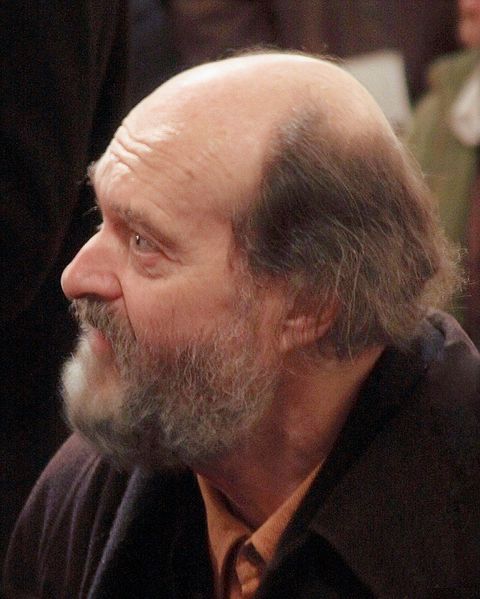
Arvo Pärt's
Tabula Rasa, an orchestral piece written specifically without a text or mythology reference in mind.
In the Soviet Union once, I spoke with a monk and asked him how, as a composer, one can improve oneself. He answered me by saying that he knew of no solution. I told him that I also wrote prayers, and set prayers and the texts of psalms to music, and that perhaps this would be of help to me as a composer. To this he said, "No, you are wrong. All the prayers have already been written. You don't need to write any more. Everything has been prepared. Now you have to prepare yourself." I believe there's a truth in that. We must count on the fact that our music will come to an end one day. Perhaps there will come a moment, even for the greatest artist, when he will no longer want to or have to make art. And perhaps at that very moment we will value his creation even more - because in this instant he will have transcended his work.
- Arvo Pärt (1935-)
When Nate took me to see the Saint Paul Chamber Orchestra's performance of
Tabula Rasa, which was the first time I heard it, I cried in front of a bunch of strangers, and I still haven't figured out why.