Showing posts with label personal. Show all posts

Tuesday, July 10, 2012

Making a recording voice

Developing a Creative Process, part 7

This is part of a series of posts on the nature of art, how I'm not as good at it as I'd like to be, and how I'm trying to be better. For the rest, see the tag Developing a Creative Process.

WHEN DO YOU NOT SOUND LIKE YOU?, or
YES, I KNOW I'M OBSESSED WITH BELLA RUSE

A lot has happened with me creatively since I last posted here. In the few weeks before my big European trip, I stopped sleeping to instead record an EP. It's kind of a big deal to me. It'll only be three tracks: a moody acoustic song with guitar performed by the hubz Nathan Eliot, a more rockin' track about science/love, and something that I hope is going to be so awesome I don't even know how to describe it I wrote with Joseph of the band Bella Ruse. He also recorded it and is producing the tracks, which means they're going to sound really good.

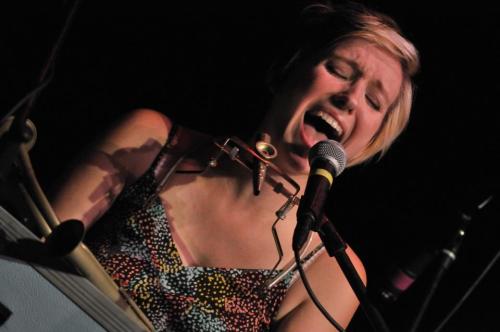
Recording was a nerve-wracking, voice-fraying experience even though I had spent time prepping with Kay, the other half of Bella Ruse (@BellaRuse). She studied opera and is a voice and piano teacher, so I was really grateful when she was generous enough to sit with me a couple of hours and work with me vocally. Joseph set up so we could record, then Kay had me try all sorts of different things with my voice: focusing on just vowels or just consonants, keeping different shapes in my mouth and different physical postures, acting different emotions. Then we listened to them and talked about them. 

Oh, um, I have those same glasses.
I was a little conflicted about the idea of consciously changing my voice to sound different. Kay has a very distinct sound when she sings, her "Bella Ruse voice." It fits their music so well; it's intimate, retro, cute and girly, but harsh when she needs emphasis or emotion. (This is an old article, but here's Kay talking about how intentional she is with her voice. A lot of Kay's words from this vocabulary post are about her BR voice.) It's probably a combination of only being trained as a vocalist in a choral setting and watching too much American Idol in high school, but the truth is that I had a prejudice against stylized voices. Most people don't think about how they sound when they talk; why should you think about how you sound when you sing? 

Of course this is ridiculous. Maybe when I'm humming about the house I actually sing the way I talk, but those long, open choral vowels I think of as the "right" way to sing aren't how people talk. It's the right way to sing in a choral setting because you have specific goals: you need to sound like the people around you, and you need the sound to carry without being amplified. Kay is a professional in a different setting with different goals: stand out from other female vocalists, be remembered, effectively communicate the intimacy that most Bella Ruse lyrics evoke. (Kay said The Bella Ruse Voice was first struck upon by recording immediately after waking up -- pretty intimate.) Kay also likes to point out one other thing: it's still her making those sounds, therefore it's her voice. Those are her sounds.

These are some of the observations that Kay and I made while listening to the different versions of my voice:
  • Vowel consistency matters to me. I think the same word should have the same vowel in different contexts. 
  • Clear articulation is what gives a recording character. This is what Kay said from the beginning: Make mistakes and do it differently every time because that's where the real character will shine through.
  • Front vowels are important. The tracks where I intentionally squashed my oral space into a wide, flat space (as opposed to the choral tall & narrow space) stand out as both closer to how I talk and more interesting. (Of course, I speak English, and English has a whole lot of front vowels and diphthongs to distinguish. This chart is cool.)
  • Thinking about how you sound makes a difference. It felt almost like I was communicating the pure phoneme, the vowel sound I hear in my head instead of the allophonic variations of it.
  • It is really, really hard to hold the ideas of how you want to sound in your head and how to do it while actually singing until you've had a lot of practice. Like picking up an accent, you'll eventually develop a new set of phonological rules and muscle memory so you can use the stylized voice even on new words and songs.
I'm not sure how well I stuck to these ideas while recording. It was a struggle to balance thinking about how I wanted it to sound with trying to give something more raw and emotive. I'm trying not to dwell on the possibility that my first recording could very well suck, but the other giant lesson from recording is something I've been trying to accept for a while now: it will capture a moment, some songs, some specific sounds -- and in the meantime, I'll move forward, making new and hopefully better things.

I guess now's a good time to direct you to MollyAndTheDreamers.com. 

Wednesday, May 2, 2012

Sound words from musicians

Developing a Creative Process, part 6
This is part of a series of posts on the nature of art, why I'm not as good at it as I'd like to be, and how I'm trying to be better. For the rest, see the tag Developing a Creative Process.
This post is a follow up to Vocabulary Building. In it, I explored the idea of learning music jargon as a tool to listen to music and eventually create music that sounds the way I want it to. 

So I sat down with three really good musicians I know really well and asked them to describe the ideal tone for their instrument, how they want it to sound. I wanted to share some of the vocab lists that came from this experiment because there are a lot of cool words that come up. 

I started by asking my husband Nathan Eliot, who plays in Talking Tree (@TalkingTreeBand), Bella Ruse, and Cardboard Dreams, as well as his own music and a zillion other projects. He plays acoustic guitar, electric guitar, electric bass, and mandola. (violin : viola :: mandolin : mandola)
positive words
fat, meaty, warm but clear, chunky, buttery, pretty and gritty
percussive, punchy, resonant, bright, natural
chocolatey, dark, round, deep, sustained

negative words
muddy, boomy, twangy, thin, abrasive, buzzy
Then I spoke with Joseph of Bella Ruse (@BellaRuse). He plays guitar, piano, and drums. He also is a recording engineer. 
positive words
meaty, clean, grit, saturates the tubes, beef
even, warm, filling up sonic space, high and low, full-bodied, crunchy
dry, character, abrasive, nasty
heavy, real, resonance

negative words
tinny, harsh, shimmer, pristine, sustained
And finally, I asked Kay of Bella Ruse. She studied opera in college. Something of constant fascination to me is that Kay sings in a very stylized voice, so these words are about her "Bella Ruse voice" and a lot of them are comparative.
positive words
old-recordy, on the high end, girly, gritty, child-like, imperfections, control, careful, airier
wobblier, wide, softened, dental, narrower, bright, breathy, wavy, tightened, bleating, character

negative words
bland
So there's a bunch of words. I'd still really like to hear someone talk about drum sounds -- not drum gear, drum sounds. 

Sunday, April 29, 2012

Linkfest [3]

A collection of language-related things that caught my attention last week:

The two basic parameters of the type family were interpreted by musical devices. Dynamics were used to translate the weight of the letter, so the music gets louder as it the letters get bolder. The width is expressed through the use of modulation, using the 4th and 7th degrees of the C major scale, playing the same musical motive.
  • I’ve been quite enjoying The Truth podcast, “movies for your ears.” I particularly liked “Tape Delay,” the episode about recutting a conversation so it’s how it should have been... and beyond. I wish I could do this.

One more thing that's not really "wordy" -- but it's fun: Here's a video of me and the hubz singing "Total Eclipse of the Heart" for our friend Moobs.


Tuesday, April 10, 2012

Inflation and despondency

Developing a Creative Process, part 3
This is part of a series of posts on the nature of art, why I'm not as good at it as I'd like to be, and how I'm trying to be better. For the rest, see the tag Developing a Creative Process.


SOMETIMES YOU FEEL LIKE YOU SUCK, or
IT’S OK TO BE AVERAGE


Here are a few different awesome songwriting experiences I’ve had in the last few weeks, followed by my feelings of crushing defeat after hearing the demos.

So cute you wanna punch her.
A couple of weeks ago, I had a really great collaborative songwriting experience with my roommate Kay of Bella Ruse (@bellaruse). The first song started with a mostly-formed song-poem I wrote that had a rhythm and a rhyme but no melody. Kay picked out some chords she liked and started humming to fit in the words. After a couple of tweaks to the melody to make it a little jazzier, we were cruising. Kay filled in a couple of lines for the chorus, we tag-teamed the bridge, and bam -- there it was. Joseph even sat in on the drum kit by the time we were running the whole thing (which means Kay was playing and singing, and I was bopping my head).

The second song started with a melody Kay had written but didn’t have any words for. She sang it through a couple of times, and I pulled up some words I had written that seemed like they might fit. They were rough around the edges and needed a lot of shaving and reshaping, but the idea (blood) fit the mood of the melody quite well. Kay ended up changing my favorite line to mean pretty much the exact opposite of what it had meant, but I rolled with it. I wrote the second verse on the spot to fit the melody and rhythm we had established in the first verse.

Considering how musically particular both Kay and I can be, it was a great experience, an exercise in flexibility and letting things happen with the understanding that they’re still “drafts,” like Joey’s talking about. Just get it out and stop worrying that it’s not all perfect. Heartbarf, knowing it will change later.


A few days later, I had a great co-writing session with my hubz Natey. Nate is a brilliant musician, but where I lean heavily on pop influences and general simplicity in songwriting, Nate intentionally makes music that is challenging for himself and the listener. I’m pretty sure he’s a genius. We’ve tried writing songs together before, but our approaches are really different; I think in skeletons and the “sound” of the whole song, and I think that Nate writes in a straight line, like he’s telling a story.

But this time, it was different. We started with another song-poem frame I had written and a chord and fancy-sounding picking frill Nate liked. I made up the melody for the first line, Nate did the second, and we pulled that trick a couple more times to mix things up. We didn’t finish the song, but we got through two verses and a kickass chorus, so I’m proud of it. Again, it was all about flexibility -- which Nate has told me all along I needed to work on when it comes to collaborating. The difference was that this time I didn’t have a thing that was already a thing that I was trying to make someone else make sound like what I heard in my head.

I learned how to write songs from Ghostwriter.
I’ve found it can be really valuable to separate myself from the words I’ve written with time. When they’re down and out of my head and in front of me, I don’t feel so bad about cutting them up and rearranging them. They feel more like craft supplies then: I’m supposed to cut the edges off to make it look pretty, even if I waste a little bit of the material. (Usually I keep any remnants I like that didn’t get used. I’ll make a quilt-song one day, I guess.)

Finally, last week, I wrote two songs on guitar, the first two songs I’ve played on guitar in months. It felt so good. I had been staying away from guitar because I felt constricted by the chord progressions (I can play “rhythm guitar” well-ish, but I don’t have much theory) -- but it wasn’t like that this time because I already had words that I was building the song around instead of filling in a chord progression with a song.

All of this is to say two things: I am awesome at songwriting and sometimes I really believe that, but I get intense feelings of insecurity and absolute disappointment in myself that all culminates with this idea: Why do I even bother? 

This was most apparent the day after Kay and I wrote together. Kay is completely amazing. Her voice is pristine and shiny and tinkles like a bell even on the iPhone demos of our half-written songs. Listening to them, I felt first a rush of pride that my words were coming out of someone else’s mouth, and so beautifully, but that was quickly replaced with a despondency that stayed with me for a couple of days: Even if I hired a voice teacher and worked my ass off, my voice does not and will not ever sound remotely close to how good Kay’s voice does. The same feeling struck me listening to the demos of Nate’s and my songs: I’ll never play guitar like that.


Yes, a lot of these feelings are related to the cycle of my hormones and my general fight against being pessimistic. To be honest, I have to inflate my ego pretty near to bursting to be able to continue writing and singing -- and those closest to me have either been told this explicitly and comply, have a deep well of patience for my narcissism, or are really in tune with my emotional and creative needs. They agree when I say I think I’m a genius (or at least resist dissenting), they smile when I’m clearly on a making-high, and they help me by accompanying, writing, playing, singing, recording, cheering, and sharing. Thank you to those people that help keep me afloat.

What I’m practicing now is acceptance of myself. I wish I were the kind of person who is driven by their deficits, but I’m not. I get bogged down by too much criticism, or the wrong kind of criticism, or even the right kinds of criticism when I’m not emotionally and mentally prepared for it. If I focus on what I’m not good at, I’m not focusing on my strengths. I’m a pretty okay singer, I’m an okayish guitar player, and that might change if I work really hard, but I think I might actually be getting good at songwriting, so I should work harder at it.

I’m also practicing joy for others when they are talented, reaping the benefits of hard work, or extremely motivated. There is not a finite amount of any of those things in the world, and I am a better person for being glad for others. Kay, Nate, and everyone else I’ve ever had a spiteful or jealous thought about: I love you, and I think you are amazing. Furthermore, you already know that about yourself, and I love you for that too.

So here’s me: writing frantically but still green, okay at guitar but lazy, piggybacking on my friends’ talents and hard work, easily discouraged by the awesomeness of others instead of inspired but trying to fight it. And the next thing I need to figure out: Why do I bother?


Maybe I'll figure it out. Stay tuned to find out: "Follow" this blog, follow me on The Twitter, bug me on The Facebook, etc etc. 

Friday, March 30, 2012

Linkfest [2]


A collection of language-related things that caught my attention last week:
  • Arabic typography links: Joey (@joeyverse) gave me a book on Arabic design which is cool. (But holy cow it has its own design flaws. So many widows; it makes me sad.) Other cool things -- 
  • Jayme (@aunicorninspace) thought this infographic on the history of western typefaces would be relevant to my interests. She was right. 
  • I loved diagramming sentences in middle school. So did this lady over at the NYTimes, so she wrote about it.
  • Idioms & The Eggcorn Database
    • From the site: In September 2003, Mark Liberman reported (Egg corns: folk etymology, malapropism, mondegreen, ???) an incorrect yet particularly suggestive creation: someone had written “egg corn” instead of “acorn”. It turned out that there was no established label for this type of non-standard reshaping. Erroneous as it may be, the substitution involved more than just ignorance: an acorn is more or less shaped like an egg; and it is a seed, just like grains of corn. So if you don’t know how _acorn_ is spelled, _egg corn_ actually makes sense.
    • In my family, there's a related phenomenon called a "Robism" after my sister Haley's husband, Rob. He's a brilliant man (cf. Untamed Science), but his brain is... different. To Rob, an idiom is just a random string of sounds. It's a toss up if he'll get the words or the usage right. I am taking the liberty of publishing some of Haley's running list here. Love you, Bert.
      • Let's crack a rip
      • By the skin of their sheets
      • Fundamental tablestone of belief
      • Smartie two shoes 
      • Bite off more than we can handle
    • When she heard me giggling over the fact that Rob doesn't know the words to "Jingle Bells" (Jingle bells, jingle bells, marching all the way), Jayme told me about the Turian race of aliens in the Mass Effect universe because she's a dork like that. Turians try really hard to incorporate human idioms into their speech and writing, but usually do it wrong:
Subject: A fly in the lotion...
Commander Shepard,
I've come to have a lot of balls in flight, as you humans say. It was brought to my attention that you're still around, working on something secret. Frankly, I hope that whatever you do keeps you far away from Noveria this time, but if you must come back and, what is it, upset the fruit cart, let me know, and I'll clear a path for you for old times' sake.
A please as always,
Lorik Qui'in, Administrator, Port Hanshan
 

  • Votes and Vowels: A Changing Accent Shows How Language Parallels Politics
    • Vowel shifts and this article are neat. Remember Mitt sayin' "y'all?" What a conniving little weiner.
    • Instead of blogging about anything I want, I've been trying to keep my writings here loosely gathered around "words," which is a pretty broad topic. But since we're already talking politics and it's my blog, I just have to say what I've been feeling explody about lately: Seriously -- Let's get back to that SEPARATION OF CHURCH AND STATE thing. Government can and should operate outside of the realm of personal and religious morality. Christianity dictates evangelism, not zealotry. From what I know of the guy, Jesus wants people to choose him, not be legally required to comply with interpretations of his teachings. It offends my Christian heritage and really all the rest of me that politicians warp goodness into a tool to mobilize the ignorance of their constituents to get them elected so they can make policy that makes them rich. Whew.

Thursday, March 29, 2012

& Other Delights

I've never seen 30 Rock, but I really like Alec Baldwin, if only because he drops "'twas ever thus" like it isn't a totally nerdy thing to say. He does this podcast called Here's the Thing, and it's just him talking with people. He's a pretty fantastic host, sharing just enough about himself to make the interviewee forget he's being interviewed and instead respond openly. Usually he's talking with actors, but my favorite episode so far features trumpet player Herb Alpert.

My hubz made me listen to the Tijuana Brass one time, and for a year in college, Whipped Cream and Other Delights, Rufus Wainwright's Poses, and Cloud Cult's Advice from the Happy Hippopotamus were the only albums I listened to while drawing or painting. (Some of that old stuff is on my DeviantArt. Hadn't looked at that in a long time, wow.) I was pleased to learn that Alpert's also a painter and sculptor -- but I also had no idea that he was a big deal producer: The Carpenters, Cat Stevens, The Police.

Mr. Baldwin and Mr. Alpert's conversation feels like a synchronicity of a sort, fitting perfectly into this discussion I've been having lately about creativity and writing and music (tagged Developing a Creative Process). Here are some lines that really resonated with me:
Alec Baldwin: Do you feel that all this technology and all of the power that comes with that has made people lazy, like people can’t get in a room and they just can’t play a song all the way through anymore?
Herb Alpert: No. I don’t think it makes them lazy. I think it gives them too many options. Now, with the digital setup, you have umpteen tracks and you can just keep going and keep going, and then you can tune them up and you can shift it around, take something that was happening at the end of the song and move it up to the front. Too many options. I think it takes some of the heart away.
Herb Alpert: I’ve been painting for 42 years. I started painting in 1970. I’m not a Sunday painter. I’m not a Sunday artist. I do it every day. Traveling in the ‘60s with the Tijuana Brass around the world, I used to go to museums, and I’d go to the modern art section for whatever reason. That just appealed to me. I see these paintings, like a black painting with a purple dot or something, hanging on the wall, and I think, “Let me try something like that.” I wasn’t doing it to think something would come of it.
I’ll tell you what’s great, and I know, Alec, you know about this. There’s something about being an artist – being a musician, being a painter, being a sculptor – when you’re doing it, you’re in the exact moment of your life, and that’s rare. When you’re not in that mode, you’re thinking about yesterday or tomorrow or some other chazerai that really doesn’t make any sense. But when you’re doing it, man, it just feels so right on the moment.
Alec Baldwin: You had no training?
Herb Alpert: No training. I didn’t know what I was doing, but I think there’s an advantage to that. I think when you’re an amateur and you’re just fooling around, you have infinite possibilities. If you go to a professional, they’ll tell you what not to do, what to do, and how to do it, and blah-blah-blah, and I didn’t know about that. I just did whatever. I’m always going for a feel. I do that in music, in sculpting, in painting. It’s like I’m not looking for something that’s going to excite my eyes. I want something that excites my soul, something that really resonates.

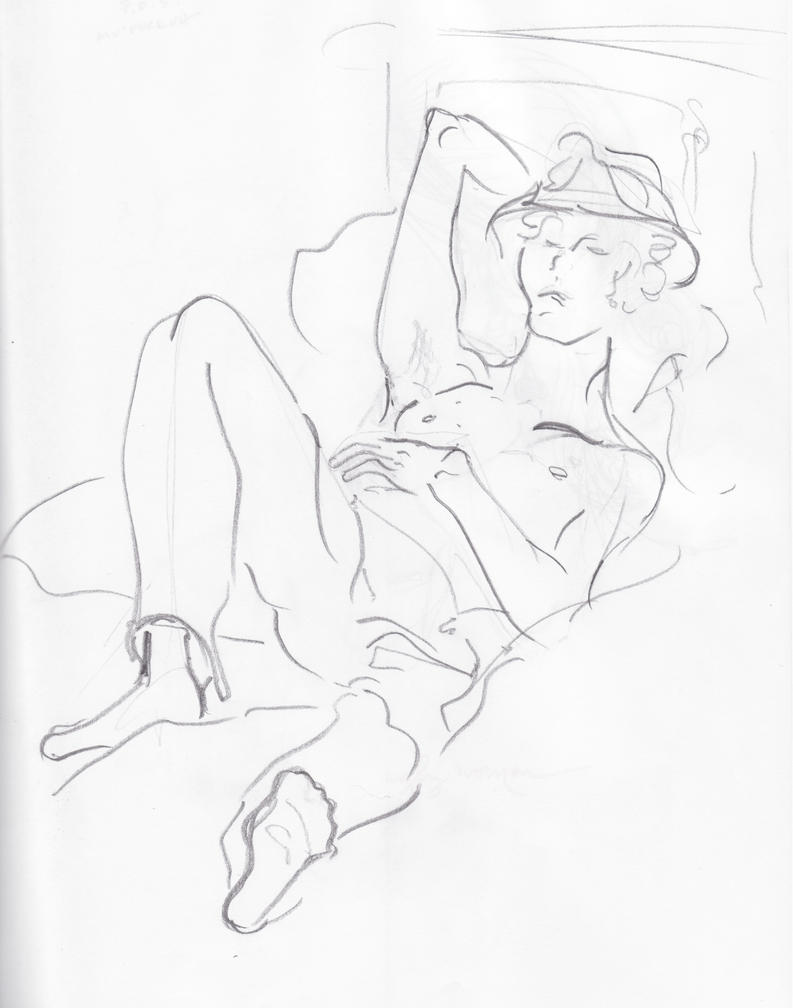
I drew this. 

Wednesday, March 28, 2012

What you might have been

Developing a Creative Process, part 2
This is part of a series of posts on the nature of art, why I'm not as good at it as I'd like to be, and how I'm trying to be better. For the rest, see the tag Developing a Creative Process.
I am fortunate enough to have a couple of friends who think about art very differently than I do, and I've been pestering them about their creative processes and perspectives in hopes that it will help me develop my own instead of staying slave to the storm.
MAYBE I SHOULD PRACTICE, or
FIRST YOU HAVE TO FIGURE OUT HOW TO BE DELIBERATE 

My second reaction to Bella Ruse (@bellaruse) saying they wanted to try some new sounds was a comparison of Joseph and Kay's ridiculous amount of skill to my lack thereof. They're both really well-trained multi-instrumentalists who have been writing, recording and touring together for a couple of years now. So Joseph being deliberate about a sound or a mood is easy for him in a way it's not for me; he's got the chops and the theory to make that shit happen tout de suite.

Sure, I could learn. I could study theory and practice my 10,000 hours until I'm a master. Am I going to? Probably not. My livelihood doesn't rely on it. But when Bella Ruse says, "We like our music now, but we want to try a different vibe," that means that Kay sits down and learns how to play guitar. Like, scales and shit. That means Joseph gets his Finn-from-Glee on and dorks it up on the drums. I admire this a lot.

Another person I really admire is Joey Lee (@joeyverse). If he says he's going to do something, he will -- and that is exactly the person I'd like to but probably never will be. Joey writes young-adult fiction (in addition to an embarrassingly long list of other skills), and at this point he's gone through the creative process so many times that he can describe it pretty effortlessly. Actually, he started doing just that on his own blog (which I totally take credit for).

Joey just finished the first draft of the sequel to his novel GEARS. Going into the writing phase of TREAD, he had a bafflingly specific outline to work from. He knows how many words each scene should be, how many words to write in a day to reach his deadlines, what writing level is appropriate for his audience, and a million other facts that are essential to the success of the work.

Not this giant.
So how does he know this stuff? I think two things: 1. he hangs out in the right places with the right people to glean this information from other people (SHOULDERS OF GIANTS, and all that) and 2. he's already done it a bunch. I guess this is where Malcolm Gladwell's 10,000 hours come in.

It's hard for us amateurs and hobbyists to catch up with those who fully commit themselves because they've not only been doing it longer, but they've been hitting it harder and reinvesting every time. Knowledge and experience work like compounding interest. Start with a little of one, get a little bit of a return on the other, reinvest, repeat. Sure, I want to punch Kay for being able to sight-read Debussy, but I wasn't there when she worked her ass off to gain the skills to be able to do that.

(Because I wish my parents did it to me, I will more than likely force my children to study piano and/or violin from an early age because I think eventually they will be glad for it. Then when Brachiosaurus and Triceratops are grown, they will probably think, "I would never put my kids through what my parents put me through," and I'll end up with amateurs for grandchildren.)

So where does this put me artistically? Right between working hard and hardly working. I am writing, writing, writing lately, and doing it with a high level of introspection so that I'm hopefully gaining as much experience as I can. Writing is a strength so I'm focusing on it. Since practicing guitar isn't, I am trying my darnedest to make those giants hold still so I can piggyback. But also, this:
It is never too late to become what you might have been.
- "George Eliot"
Really, that perspective is a lot more... optimistic? goal-oriented? intentional? than I am. I don't want to "be" anything. So why am I doing it? Why am I thinking about it and writing about it?

Why am I a taster? Why a jack of all trades and master of none? Or maybe it's not just me. This popped up just as I was about to hit "Post" --

Monday, March 26, 2012

Deliberate creativity

Developing a Creative Process, part 1

Until recently, I thought creativity was something that just happened to you. When I make a song or write a blogpost or paint a picture or construct a dollhouse, it's a storm that falls on me: immediate, all-consuming, impossible to willfully incite, and over when it's over. This means
  1. I am not deliberate about content, so what I make is often overly personal 
    • (Or at least the seed for the idea is)
  2. I therefore become attached to what was created as an extension of myself
    • I place value on the creation as a product of the furystate in which it was born
  3. Once it is tangible, I abandon it because 
    • I don't like/can't handle criticism because it feels like criticism of me instead of the work
    • I don't want to "be" a musician or a painter or a writer so I don't "do" anything with it
    • I feel emotionally purged, so what else is there?
I am fortunate enough to have a couple of friends who think about art very differently than I do, and I've been pestering them about their creative processes and perspectives in hopes that it will help me develop my own instead of staying slave to the storm.

LETTING GO OF SELLING OUT, or
IT'S OKAY TO BE DELIBERATE

Joseph and Kay are the indie rock duo Bella Ruse (@bellaruse), and sometimes they play as a band with my hubz Nathan Eliot and our friend Alex (@alexyoungdrums). When Bella Ruse came back to the Twin Cities after SXSW, I was surprised to hear Joseph describe some of the changes that he and Kay were planning for their music careers -- really specific changes that they think will help them make their living as musicians. 

Since writing for me feels more like a dam breaking than a deliberate act of creation (Far Side at right is what came to mind as I wrote that sentence), my reaction was something like, "You can just decide that sort of thing?"

Joseph insists -- rather emphatically, actually -- that music or any creative endeavor is exactly no different than any other endeavor you do for money. It's a business. He loves making music, but the specific kind of music he ends up making is less important than him getting to spend his life making it.

I'mmabe real -- Gut reaction was "Isn't that selling out?" It honestly surprised me that Joseph has this perspective because his music and his lyrics are really, um, feely. I guess I just assumed he got the same emotional satisfaction from songwriting that I do, which he very well may for all I know -- but the point is that being intentional isn't being any less creative. 

I can be deliberately creative: I sketch on the canvas before I paint, I can outline the pants off an essay, and a lot of thought goes into the wallpaper choices of a dollhouse. But it's not the same with songwriting or even creative writing for me. Writing academically, doing stupid crafts, and even painting do not leave me emotionally clean and empty like when I write a song or journal (writing without my brain, what I call "heartbarfing"). I guess this is the line for me between "art" and "craft" : at some point in its creation, art provides an immediate emotional experience for the artist.
This is part of a series of obnoxiously personal and verbose introspective posts on the nature of art, why I'm not as good at it as I'd like to be, and how I'm trying to be better. Stay tuned with the tag Developing a Creative Process. 

Thursday, March 8, 2012

Art, music, language, feelings

I may be exaggerating if I say that Scott McCloud's Understanding Comics (previously mentioned in this blog) changed my life, but it was a part of my life during a formative time. I read it in my first year of college, which happened to be when I was starting my first linguistics class. I think it was loaned to me by my friend Drew who knew I liked drawing, and it was offered to me more as an art reference. But what I really got out of it was the surprising realization that words and art are really not that different: they are abstractions of the real world, a distorted reflection, a shadow on the wall of a cave.

At the same time, I was being taught just how awesome language is -- the intricacies of the vocal tract and hearing organs, the complexities of grammar and syntax, how we use language to relate to one another -- and language seemed like a god to me, which I guess makes Saussure Jesus. If anything could capture the wall shadows and sew them back onto reality's feet (mixing metaphors and literary allusions, woah), language would be that thing.

But I'm continuing to feel like it's sometimes not enough. I just can't find words big enough or small enough or accurate enough lately. I know that it's possible for words to come close, oh so close, to capturing something beautiful (see Rothfuss post, and forthcoming Card post), so it's just that I'm not wielding them with enough skill.

The only thing that has come close to mimicking or reflecting my feelings lately -- which I know are really strong and too many -- is music, usually with lyrics. It's probably not a coincidence that the times I've felt most wordless (now, for whatever reason; writing my thesis; when there's stress or tragedy afoot) are my most prolific periods as a songwriter. Compound mediums are powerful.

My hubz Nate just "gets" instrumental music (classical, jazz) more than most, certainly better than I do. He's of the school that music without words, if done well, offers a more direct route to thoughts or feelings than words can. My objections have always been, well, 1. I'm bored (but this is just me being dumb) and 2. whose feelings are being communicated? Without words, the music is up to interpretation a lot more than music with words, so whose emotion is it reflecting -- the composer, the performer, the listener?

All of these are valid answers, and this is, in fact, why I think Nate appreciates wordless music: its interpret-ability. I myself almost always prefer the hit-them-over-the-head-until-they-completely-understand-exactly-what-I'm-saying approach when it comes to communication (I lecture, I share too much, I ask personal questions; if I have a thought, it's hard to keep it to myself). But then I think about how Rothfuss-as-Kvothe glosses over his time with Denna: it's too private to share. The beauty of the moment is left more intact by not teasing it apart too much. Omission and implication are also powerful.

Maybe I talk and write too much, use too many words. Maybe the subsequent thought after "Words simplify reality" should be "And when you don't want them to or they can't, don't use them. And that's okay."

All of this is part of a discussion on "What is art? Who is art for?" -- or maybe "Why is art?" -- that I find generally exhausting and circular, so I'll stop. But I will share the music that's been strumming my pain lately: the Punch Brothers' new album Who's Feeling Young Now?, particularly, "Who's Feeling Young Now?" and "Soon or Never." Also all their other music.

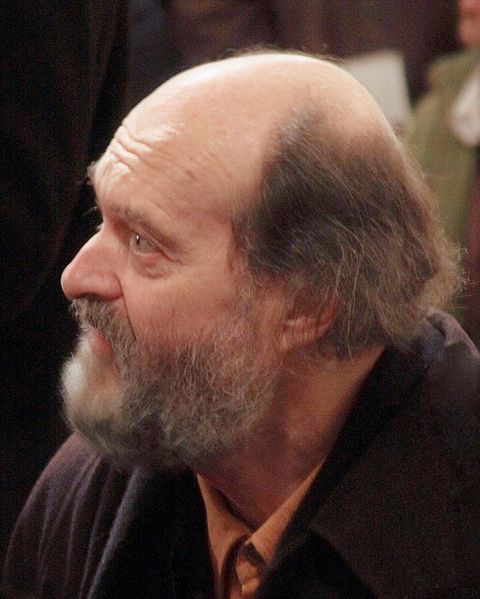
There is one piece of music-without-words that slays me every time: Arvo Pärt's Tabula Rasa, an orchestral piece written specifically without a text or mythology reference in mind.

In the Soviet Union once, I spoke with a monk and asked him how, as a composer, one can improve oneself. He answered me by saying that he knew of no solution. I told him that I also wrote prayers, and set prayers and the texts of psalms to music, and that perhaps this would be of help to me as a composer. To this he said, "No, you are wrong. All the prayers have already been written. You don't need to write any more. Everything has been prepared. Now you have to prepare yourself." I believe there's a truth in that. We must count on the fact that our music will come to an end one day. Perhaps there will come a moment, even for the greatest artist, when he will no longer want to or have to make art. And perhaps at that very moment we will value his creation even more - because in this instant he will have transcended his work.
- Arvo Pärt (1935-)
When Nate took me to see the Saint Paul Chamber Orchestra's performance of Tabula Rasa, which was the first time I heard it, I cried in front of a bunch of strangers, and I still haven't figured out why.

Tuesday, March 6, 2012

The power of words


It's amazing the things that words can do.  From a short, sweet philosophy paper by Rachael Briggs on how exactly S may not know that p:
Annabella Milbank believes that she is decent and upstanding. And indeed she is; her belief flows from her decent and upstanding character. She could, however, be easily corrupted. If corrupted, she would become so desensitized to decency that she would continue to believe she was decent and upstanding (albeit unfairly maligned by puritanical society). So Annabella’s belief is not sensitive to the proposition that she is decent and  upstanding. Nonetheless, Anabella appears to know that she is decent and upstanding.
I have to admit that I hated logic, even the tiny bit I had to know for studying pragmatics. But so far, this Introduction to Logic has been refreshing. Words are able to capture such complex thoughts!


But --
I thought about writing today, and how strange it is that I very often write without meaning to communicate to others. Surely this is a recent phenomenon in the history of language. I write fiction and poetry, I journal, I write songs -- and no one (or very, very few people) ever read or hear these things. For me, writing makes my brain organize a mess. I don't like the sound of calling it therapeutic, but it gives me the same feeling that really thoroughly cleaning my kitchen gives me: control. dominion. power to define.

Very often I write to process emotions, but here I want to undermine what exactly words are capable of. Today I had the distinct feeling that the words were not enough, that I was stuffing my emotions into little wordboxes even though they weren't quite what I was feeling. (Maybe I'm just not the kind of writer I want to be.) Instead of the storm of thoughts and feelings, I named the temperature, the speed and direction of the wind, and the barometric pressure. I didn't do the storm justice, but everything seemed a little more manageable.

I guess I'm not undermining words at all. It's just that, instead of capturing reality, right now, for me, the power of words lies more in simplifying reality, cutting it up into bite-size pieces so I'm able to swallow. Is this what I've always done? How complex would my world be if I only had thoughts instead of words? Does this make any sense?